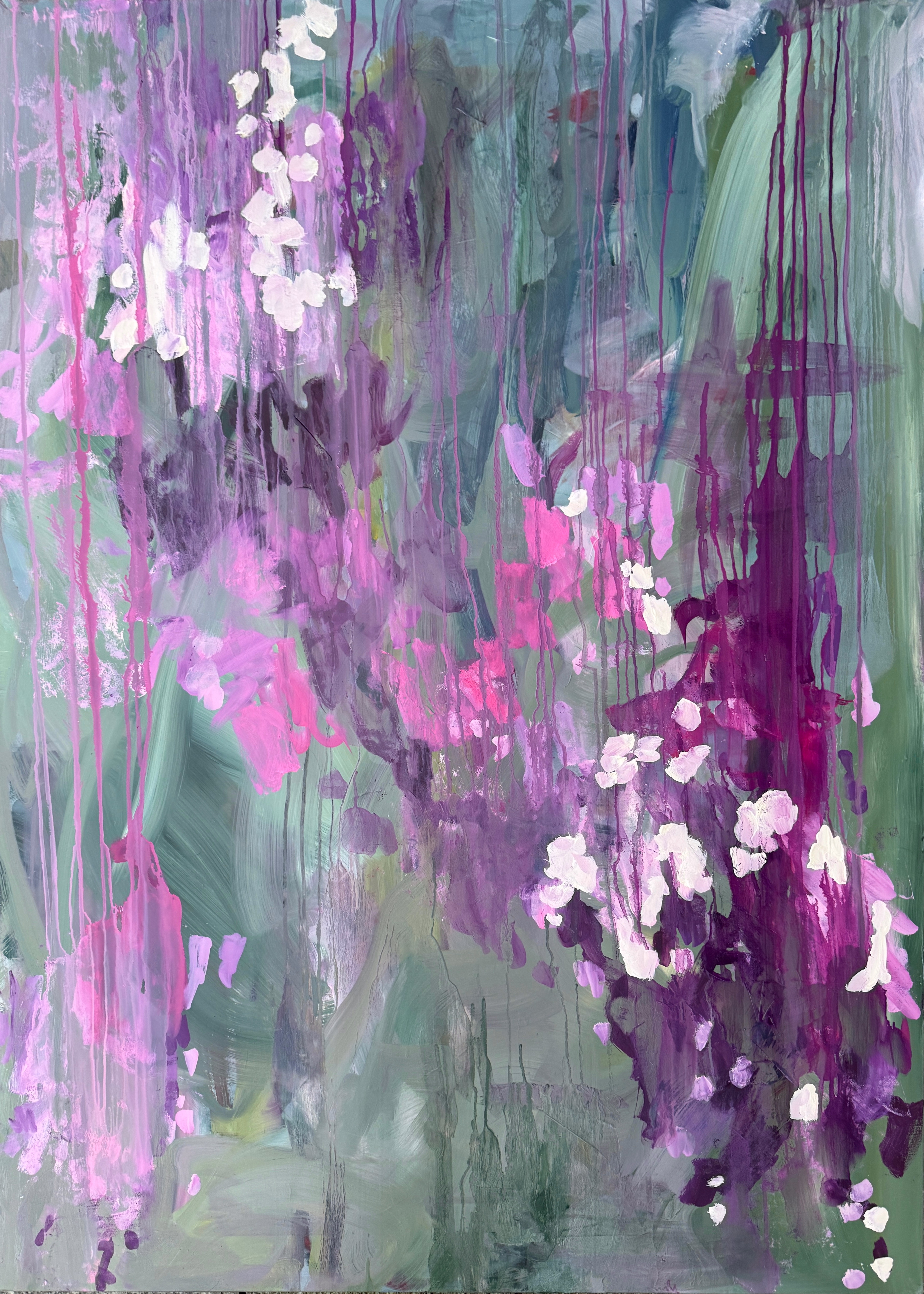
In my abstract paintings, drawing upon elements of floral still life, I explore the complexities of being human—where impermanence, vitality, and decline coexist. Rather than treating the painting as neutral description, I approach it as a time-based proposition. The image is anchored in an encounter that is already passing, and the act of painting becomes an attempt to suspend that passage, however provisionally, by extending the duration of looking. What is ordinarily invisible, time’s incremental erosion, becomes legible through process.
For me, painting does not simply represent transience; it stages it, translating duration into matter and making time visible as a layered record of work, looking, and change. The work operates within the lineage of memento mori, not as dramatic allegory but as a material and perceptual discipline. The flower’s brevity oHers a compressed model of human experience of time, youth, illness, aging. These are made visible through surface, colour, and texture. I am influenced by the work of Flora Yukhnovich and Joan Mitchell.
Layering and revision in oil and acrylic become conceptual as well as technical decisions. Opacity, glazing, and abrasion articulate how the self is constructed and undone, how presence can be intensified even as it approaches disappearance. Each gestural or abstract mark operates as both image and trace. This renders duration perceptible, an index of time spent, time withheld, time returned to. As I work, I remain open to the organic process of creation where moments of serendipity play as much a role as intention. The abstract, dissolving elements represent the passage of time, the fragility of life. The painted surface functions as an index of encounter; it holds the residue of decisions made in real time, making visible the human presence captured in that moment of looking.
Central to the work is the botanical paradox of ornament and chemistry. My background in pharmacy sharpens my attention to plants as complex material agents rather than passive symbols. Many blooms carry compounds that are simultaneously therapeutic and toxic, and the boundary between remedy and poison is often a question of dose, context, and exposure. Fragrance and hazard, care and risk, are materially entangled. This duality complicates the conventional association of flowers with sentiment or decoration.
By foregrounding the flower as both seduction and warning, I propose beauty as a charged encounter rather than a passive pleasure. Painting, for me, functions as a method of durational looking that resists instant consumption. At the threshold where splendour gives way to decay, the works invite reflection on visibility, impermanence, time and what it is to be human.