

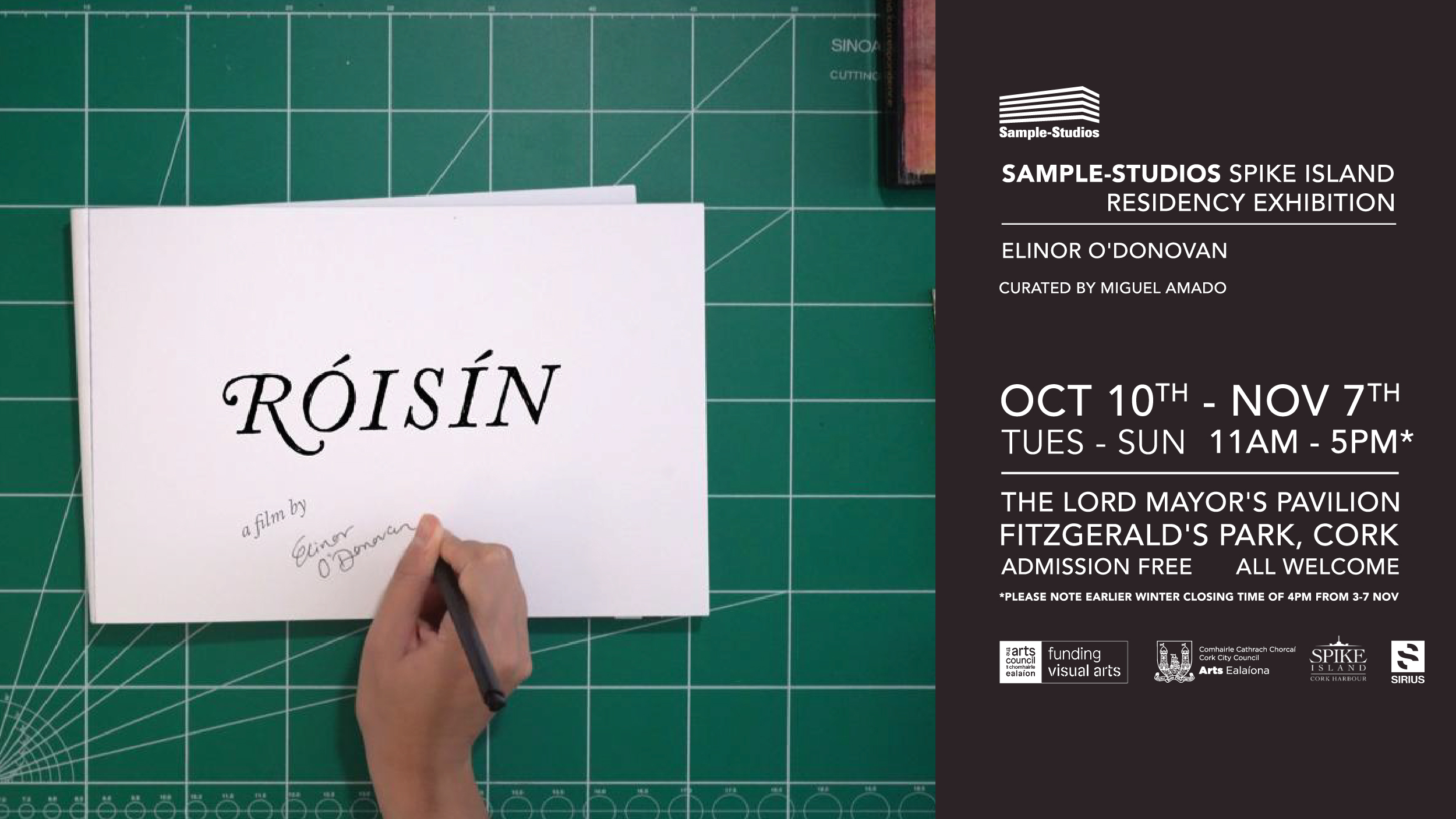

Róisín is a new exhibition by Elinor O’Donovan comprising a film of the same name and an accompanying wall installation. This work was completed through the Sample-Studios Spike Island Summer Residency is delivered in partnership with Spike Island and Sirius Arts Centre. This initiative is supported by the Arts Council.
The exhibition centres on Róisín, a film exploring the life of Charlotte Grace O’Brien (1845–1909), O’Donovan’s great-great-great-great aunt. O’Briend was a writer, campaigner and plant collector who worked on behalf of Irish women emigrating to America in the late nineteenth century. She campaigned against the conditions they experienced in Queenstown, now Cobh, aboard emigrant ships and upon their arrival in New York.
The film takes the form of a ‘desktop documentary’. Its narrative is illustrated by browser windows, archival materials, drawings and digital imagery, mirroring O’Donovan’s research into O’Brien’s life. Róisín recreates fragments of O’Brien’s story through the materials and connections encountered during research, moving visually between analogue and digital ‘desks’. This process took O’Donovan from Cork to Dublin, Limerick and New York, through archives, libraries, botanical collections and places connected to O’Brien’s life.
The film follows O’Brien’s journey from Ireland to New York and back again, tracing her work with emigrant women alongside her later interest in gardening and botany. Wild roses become a recurring motif, connecting the migration of Irish women with the movement and dispersal of plant life.
The exhibition’s title references this wild rose motif, as well as cultural depictions of Irish women in the 19th-century, particularly those which depicted Ireland as a female figure, such as ‘Hibernia’ and ‘Mother Ireland’ and ‘Róisín Dubh’. An accompanying wall installation references decorative floral plasterwork found in Irish state buildings, including Leinster House. These motifs extend the exhibition’s interest in the relationship between flowers, women and the visual language of Irish nationhood.
O’Brien’s life illuminates the intertwined histories of Irish nationalism, women and ecology. By recentering figures and forms of life sidelined in the nation-building of the Irish state, Róisín considers what new possibilities they might offer Ireland’s political imaginary.
Róisín continues O’Donovan’s interest in the ways that stories shape worldviews, and in the blurred boundaries between fact and fiction. Extending her use of familiar images, cultural references and speculative narratives, the exhibition turns to the symbols through which Ireland has been imagined, considering how these might be reinterpreted and given new meaning. In doing so, Róisín suggests that Ireland’s political imaginary is not fixed, but remains something we are capable of shaping.
This exhibition is a collaboration between Sample-Studios, Spike Island and Sirius Arts Centre, with support from the Arts Council of Ireland and Cork City Council.
Opening Reception
The Opening Reception will take place on 10 October from 2-4:30pm. This will commence at 2pm in Cork Public Museum, Fitzgerald’s Park, where Elinor O’Donovan is In Conversation with Dr Tom Spalding, Historian and Assistant Lecturer in Visual Culture at Munster Technological University. The event will continue at 3pm with a reception in O’Donovan’s exhibition Róisín in The Lord Mayor’s Pavilion adjacent to the Museum.
